

The salvage yard smelled like rain-soaked cedar and old nails. Three aisles in, past a stack of mismatched ceramic sinks and a row of antique doorknobs organized by decade, a builder from Portland was loading oak floorboards into his truck—boards that had once been the gymnasium floor of a 1950s elementary school. They were headed for his kitchen. That scene, repeated thousands of times a day across the country, captures where home renovation is heading. Salvaged materials meet modern DIY in ways that are reshaping not just individual homes but the entire conversation around waste, value, and craft.
Interest in reclaimed materials isn’t a niche hobby anymore. According to the Environmental Protection Agency, the United States generated over 600 million tons of construction and demolition debris in 2018 alone, and more than 145 million tons of that ended up in landfills. Meanwhile, the reclaimed lumber market has been growing at a compound annual rate exceeding 4%, driven by homeowners who want character that big-box stores can’t replicate and a footprint that landfills don’t have to absorb.
This guide walks through practical, tested ideas for bringing salvaged materials into your home—whether you’re a first-time DIYer with a borrowed drill or a seasoned renovator looking for your next project.
Why Salvaged Materials Deserve a Second Look
There’s a common misconception that reclaimed materials are a compromise—something you settle for because it’s cheap or because you’re trying to be environmentally virtuous. That framing gets it backward. Old-growth timber pulled from a demolished barn is denser, harder, and more dimensionally stable than anything you’ll find at a lumber yard today. Trees harvested a century ago grew slowly in competitive forests, which means tighter grain rings and wood that has already spent decades acclimating. It isn’t going to warp the way freshly milled pine will.
Beyond quality, there’s the question of uniqueness. A farmhouse table built from reclaimed heart pine carries a patina—nail holes, saw marks, subtle color variation—that no distressing technique can convincingly fake. In a market saturated with mass-produced furniture, that individuality has real monetary value. Appraisers and real estate agents increasingly note that well-executed reclaimed features can distinguish a property in competitive markets.
Then there’s the environmental math. Producing virgin lumber, brick, or metal requires significant energy. Reusing existing materials sidesteps most of that embodied carbon. The Delta Institute has estimated that deconstruction and salvage can divert up to 90% of a building’s materials from landfills, compared to roughly 30% for standard demolition practices.
How do I find salvaged building materials near me?
Start local. Habitat for Humanity ReStores operate in most mid-sized and large cities, selling donated building materials, fixtures, and furniture at a fraction of retail prices. Architectural salvage companies—which specialize in pulling high-quality materials from buildings slated for demolition—are another reliable source. Websites like Craigslist, Facebook Marketplace, and Freecycle frequently list materials from homeowners mid-renovation who’d rather give away old cabinets or hardwood than pay for a dumpster.
For larger projects, ask local demolition contractors whether they allow “salvage walks” before teardown. Some do, especially if you’re willing to remove materials yourself. And don’t overlook estate sales, farm auctions, and even curbside finds in neighborhoods with older housing stock.
Fresh DIY Projects Using Salvaged Materials
The gap between inspiration and execution trips up a lot of people. You scroll through photos of stunning reclaimed wood accent walls, feel motivated, and then stall because you don’t know where to begin. These projects are organized from simplest to most involved, each with enough detail to move from idea to finished piece.
Reclaimed Wood Floating Shelves
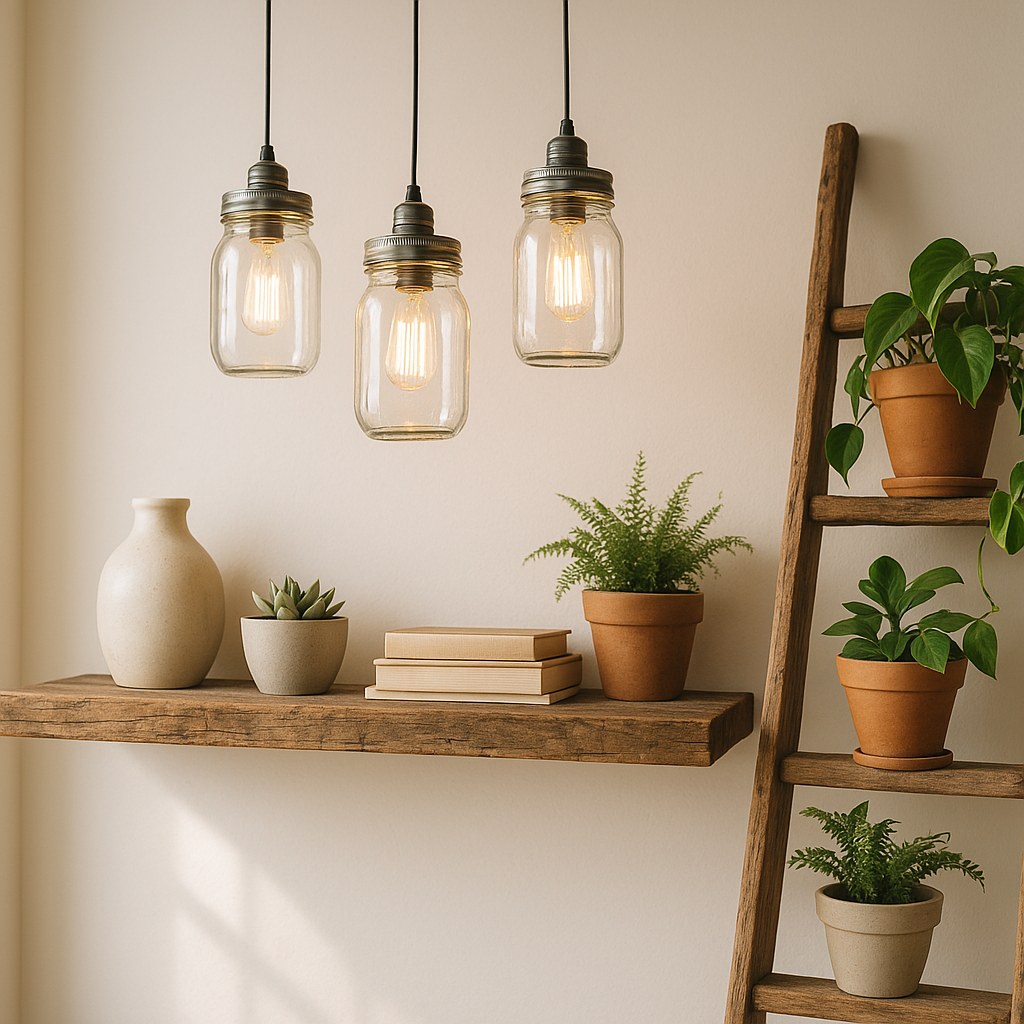
This is the gateway project for most salvaged-material DIYers, and for good reason. Old barn wood, gymnasium flooring, or even thick planks pulled from a decommissioned fence can become striking floating shelves with minimal tools. Cut your boards to length, sand them lightly (you want to remove splinters, not character), apply a matte polyurethane or natural oil finish, and mount them with concealed bracket hardware rated for the weight you plan to display.
One practical tip: if the wood has any cupping or twist, don’t force it flat during installation. A slight natural curve actually reads as intentional once the shelf is loaded with books or plants. Choose boards at least 1.5 inches thick for visual weight—thin salvaged planks can look flimsy as shelves.
Salvaged Door Headboard
An old panel door, turned horizontally and mounted to a wall or attached to a simple frame, makes one of the most satisfying weekend projects in this category. Five-panel doors from the early-to-mid twentieth century work especially well because their proportions suit a queen or king bed. Look for solid-core doors at salvage yards—they typically run between $20 and $75, far less than a manufactured headboard of comparable visual impact.
Strip old paint carefully if the door predates 1978, since lead-based paint is a real hazard. A heat gun on a low setting combined with a carbide scraper works well. If the existing paint is in good condition and tests negative for lead, you can simply clean, lightly sand, and seal it with a clear coat to preserve the aged finish.
Repurposed Window Frame Greenhouse
Old single-pane windows are among the most commonly available salvaged items—they’re pulled out by the thousands during energy-efficiency upgrades. A collection of matching or near-matching frames can be assembled into a small cold frame or lean-to greenhouse. The process involves building a simple lumber frame to the dimensions of your collected windows, then hinging the window sashes to the frame for ventilation access.
This project rewards patience in sourcing. Collecting eight to twelve windows of roughly similar size might take a few months of watching listings. But the result—a functional, charming structure that cost a fraction of a commercial greenhouse kit—is worth the scavenger hunt.
Salvaged Brick Garden Edging and Pathways
Old bricks, especially the rough-edged, slightly irregular ones from pre-1950s construction, make garden paths and bed borders that look like they’ve been in place for generations. Unlike modern pavers, salvaged bricks have natural color variation from the firing process—some darker, some with a blush of iron oxide—that creates visual depth without any pattern-laying skill on your part.
For a basic pathway, excavate about four inches, lay a compacted gravel base, add a layer of sand, and set the bricks in a herringbone or running bond pattern. Sweep polymeric sand into the joints to lock everything in place. A 50-square-foot path typically requires around 250 to 300 standard bricks, which you can often source for $0.50 to $1.00 each at salvage yards—sometimes free if you’re willing to haul them from a demolition site.
Industrial Pipe and Reclaimed Wood Furniture
Combining salvaged wood with black iron or galvanized pipe produces tables, shelving units, and desks with an industrial aesthetic that remains popular for good reason—it’s durable, functional, and forgiving of imperfect materials. A slab of reclaimed Douglas fir paired with pipe legs can become a dining table that would retail for $1,500 or more. Your material cost might run $150 to $300 depending on the wood source.
The key to making this look intentional rather than improvised is consistency in your pipe fittings. Stick to one finish—either black iron or galvanized, not both—and plan your dimensions carefully before cutting any wood. Pipe fittings are threaded and can be adjusted, but wood can’t be un-cut.
Are Salvaged Materials Safe to Use in My Home?
This is probably the most important question in the entire process, and it deserves a direct answer: yes, with caveats. The primary concerns are lead paint (pre-1978), asbestos (found in some old floor tiles, insulation, and siding), chemical treatments (railroad ties and some pressure-treated lumber), and structural integrity.
For lead paint, inexpensive test kits are available at any hardware store. If a painted surface tests positive, either strip it using appropriate safety measures (respirator, containment, wet methods) or encapsulate it under a new finish. Never dry-sand unknown paint on old materials.
Structural wood should be checked for rot, insect damage, and excessive checking or splitting. A simple awl test—pushing a sharp tool into the wood—reveals soft spots that indicate decay. Minor surface checks and small insect holes (especially old, inactive ones) are cosmetic, not structural.
Railroad ties, while tempting for garden projects, are typically saturated with creosote, a known carcinogen. Skip them for garden beds or any application where they’ll contact soil you grow food in. The same caution applies to older pressure-treated lumber, which was treated with chromated copper arsenate until the EPA phased it out in 2003. If you’re concerned about what older materials might release into your living space, these practical tips for a healthier living environment can help you address indoor air quality alongside your renovation work.
Can I Use Salvaged Materials in a Modern or Minimalist Home?
Absolutely, and the contrast is often what makes it work. Reclaimed materials don’t belong exclusively to farmhouse or rustic design. A single salvaged beam installed as a floating mantel in an otherwise clean-lined living room creates a focal point that pure minimalism lacks. Designers sometimes call this “warm minimalism”—the strategic use of aged, textured materials to keep spare spaces from feeling sterile.
The trick is restraint. Instead of cladding an entire room in barn wood, choose one element: a salvaged marble threshold repurposed as a bathroom shelf, a set of reclaimed library card catalog drawers used as a coffee table base, or old-growth lumber milled into clean-edged countertops. The tension between old and new is what gives the space energy.
What’s the Difference Between Salvaged, Reclaimed, and Upcycled?
These terms get used interchangeably, but they describe slightly different things. Salvaged materials are rescued from buildings or structures being demolished or renovated—think bricks, beams, doors, and fixtures pulled from a teardown. Reclaimed typically refers to materials that have been processed or prepared for reuse, like reclaimed lumber that has been de-nailed, kiln-dried, and re-milled. Upcycled describes items transformed into something of higher value or different function than the original—turning a ladder into a bookshelf or an old suitcase into a side table.
Understanding the distinction matters practically because it affects price and preparation. Salvaged materials are the cheapest but require the most work. Reclaimed materials from a dealer have already been processed and carry a premium, but they’re ready to install. Upcycled projects are limited only by imagination but require the most creative problem-solving.
Making It Work: Practical Tips for First-Timers
Start small. A shelf, a coat rack, a planter box—projects that can be completed in a weekend with basic tools. These build confidence and teach you how salvaged materials behave differently from new ones. Old wood is harder and more prone to splitting, so pre-drilling is essential. Mismatched bricks require more mortar adjustment than uniform new pavers. These aren’t reasons to avoid salvaged materials; they’re simply characteristics to work with rather than against.
Build relationships with your local salvage sources. The owner of an architectural salvage yard who knows you’re looking for a specific type of door or a particular species of wood will set things aside for you. That kind of sourcing relationship is worth more than any single find.
And accept imperfection as part of the aesthetic. A reclaimed wood table with a visible nail hole or a brick path with slight color shifts isn’t flawed—it’s honest. It tells a story that a freshly manufactured product cannot. These kinds of hands-on projects are also among the small lifestyle upgrades that can meaningfully improve how you feel in your own space.
Conclusion
The intersection of salvaged materials and modern DIY isn’t a trend that will fade with the next design cycle. It reflects something more durable: a growing recognition that quality, character, and sustainability don’t have to be competing priorities. Whether you’re building floating shelves from a torn-down fence, assembling a greenhouse from discarded windows, or laying a garden path with century-old bricks, each project diverts material from landfills while adding something genuinely distinctive to your home. The materials are out there—in salvage yards, on curbs, in barns waiting to be demolished. The only real requirement is the willingness to see possibility where others see waste.
Leave a Reply